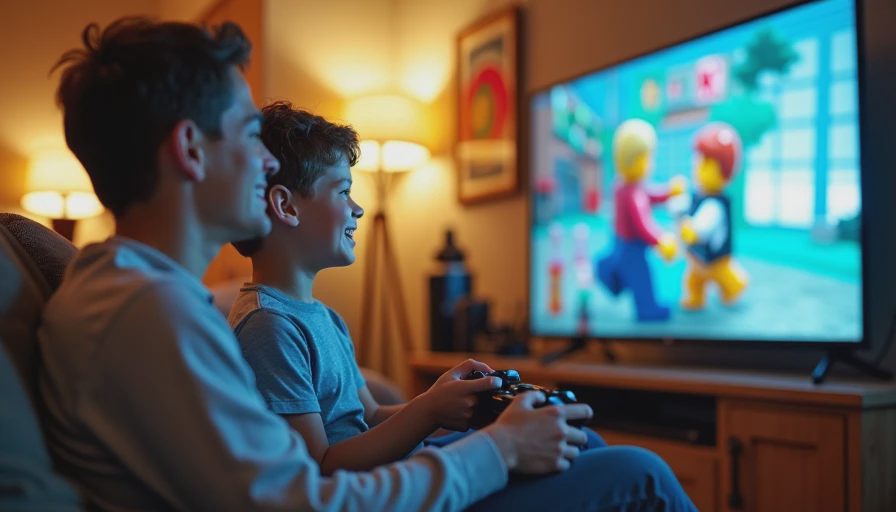
Owen is eight. He likes building, smashing, and the exact moment a character finally unlocks the piece that lets him reach the next ledge. We play LEGO games together on the couch—usually on a weekend afternoon when the energy in the house is still high and no one has homework yet.
Those sessions taught me something I did not expect: most adult games are far too willing to waste the player’s first hour, and I am no longer willing to defend it.
LEGO games are not subtle about teaching. They put the new mechanic in your path. They let you try it immediately. They celebrate when it works. If you miss the hint, the game usually finds a second, still-gentle way to show you. The result is that an eight-year-old can climb the skill curve without feeling stupid and without needing a parent to pause and explain the UI. Progress feels like play the entire time.
Then I go back to a “serious” game and watch it dump three full screens of controls, a skill tree that assumes I already understand the secondary resource system, and a combat encounter that punishes me for not having internalized a mechanic the game has not yet clearly demonstrated. The contrast is not flattering.
What the LEGO sessions made obvious
Clarity is not the enemy of depth.
A clean introduction does not make a system shallow. It simply stops treating the player’s early attention as infinite. LEGO games still layer abilities, characters, and routes. They just refuse to make the first contact with each new idea feel like homework.
Failure should teach, not scold.
When Owen misses a jump or uses the wrong tool, the game lets him try again quickly. There is almost no long recovery animation, no distant checkpoint tax, no lecture. Adult games often add friction at exactly the moment the player is still learning, then call the resulting struggle “challenge.”
Shared attention is a feature, not a bug.
Couch co-op in these games works because both players can understand what is happening without constant explanation. That same quality makes solo play better too. If a system is clear enough for a parent and kid to share, it is usually clear enough for a tired adult playing alone at 9:30 p.m.
The first hour is not disposable.
LEGO games treat the opening as part of the fun. Many adult titles treat it as a necessary evil that “serious” players will simply endure. After enough weekend sessions with Owen, I stopped respecting that bargain. My patience is not more abundant than his just because I am older. It is often more scarce.
The practical effect on how I review
I now flag slow, muddy, or arrogant tutorials more quickly. If a game needs a long text dump or a combat gauntlet that assumes knowledge it has not taught, that belongs in the early verdict. Time to Fun starts at the title screen, not after the game has finished explaining itself.
I also give more credit to systems that introduce ideas the way the better LEGO titles do: show the tool, let the player use it, then build on it. That approach respects both the eight-year-old on the weekend and the thirty-six-year-old who only has ninety minutes after bedtime.
Playing with Owen did not make me want every game to be a LEGO game. It made me less willing to accept unnecessary friction dressed up as sophistication. If a design can teach an eight-year-old without condescension, it can teach me without wasting my evening.

A game doesn’t need to be perfect. It needs to earn the hours. The ones that remember how to teach cleanly earn them from the first minutes—together on the couch or alone after the house is quiet.


No notes yet — write the first.